Newsletter Subscribe
Enter your email address below and subscribe to our newsletter

 ByJohn A
Packaging is where a product meets the customer. A biscuit, a bag of kibble, or a sachet of sauce can be perfectly made and still fail if the pack leaks, tears, or arrives looking sloppy. For food and pet food producers, the machinery behind the pack matters as much as the recipe.
Many buyers now source equipment from Chinese factories, because the range of pouch machines, fillers, and complete lines is wide and the engineering has matured considerably. If you are comparing a China Packaging Machine manufacturer for the first time, it helps to know what to ask, what to test, and how to separate a well-matched supplier from one that simply sends a good quotation. The rest of this guide covers the fundamentals.
Flexible pouches have taken share from cans, jars, and rigid trays in many categories. The reasons are practical rather than fashionable.
These advantages only materialize if the machine matches the pouch style, the film structure, and the product. That is why the type of machine should be chosen after you understand your product, not before.
A VFFS machine forms a bag from a roll of film, fills it from above, and seals it. It suits pillow bags, gusseted bags, and quad-seal bags. Snacks, rice, frozen vegetables, powders, and dry pet treats are typical products. VFFS machines are fast and compact, and they pair well with multihead weighers for accurate portions.
Rotary machines pick up preformed pouches, open them, fill them, and seal them. They are the usual choice for stand-up pouches, zipper pouches, and spouted pouches. Because the pouches are already made, the seal quality and print appearance tend to be excellent, which matters for premium retail packs. Buyers pay more per pouch than with roll film, so the format suits products where presentation supports the price.
HFFS machines work in a horizontal orientation and are well suited to products that must be laid flat or handled gently, such as single-serve items and some shaped foods. They are less common than VFFS for bulk granules but valuable for particular applications.
Wet foods, sauces, and ready meals may need retort pouches that withstand heat sterilization. These demand tighter control over seal integrity, and the filling equipment must handle liquids or chunky products cleanly without contaminating the seal area.
The single most common cause of disappointing performance is a mismatch between the product and the filling method. Consider the physical behavior of what you are packing.
Free-flowing dry products such as grains, seeds, and small kibble usually work well with volumetric cup fillers or multihead weighers. Sticky or fragile products such as coated snacks or delicate biscuits need gentler handling and sometimes special chutes to prevent breakage. Powders create dust, which can contaminate seals, so dust extraction and auger fillers become important. Liquids and pastes call for pumps or piston fillers, and the machine must be designed to handle drips and foaming.
Ask any supplier to explain, in plain terms, how the machine will handle your specific product. A good answer includes details about bulk density, particle size, stickiness, and how those factors affect filling accuracy and seal quality.
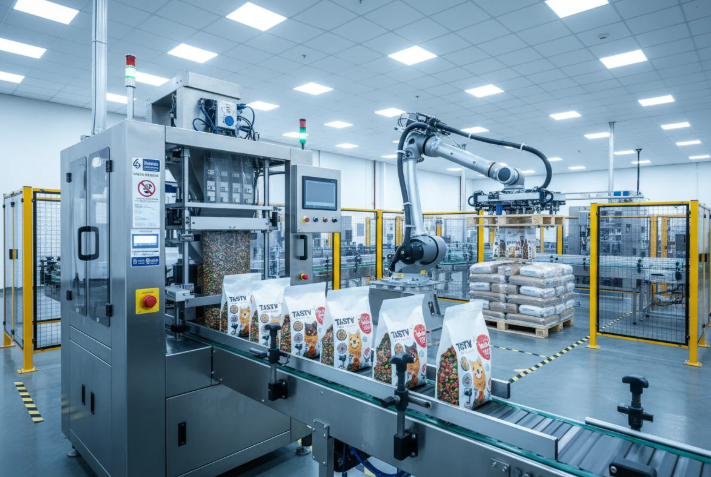
A single pouch machine is only one link in a chain. Before the pouch is filled, the product must be conveyed, weighed, and sometimes inspected. After sealing, packs must be checked, coded, cartoned, and palletized. A turnkey packaging line integrates these steps into a coordinated system, typically including:
The main benefit of a turnkey approach is accountability. When machines from different makers are strung together, problems at the interfaces can be difficult to trace, and each supplier may point at the others. With an integrated line, one team is responsible for how everything works together. The trade-off is that the project is bigger, so specifications, layout drawings, and acceptance criteria need to be agreed in detail before manufacturing begins.
See also: Peter Thomas Roth Wiki Biography Career and Business
Food producers face requirements that go beyond speed and cost.
Contact surfaces should be food-grade stainless steel, with smooth welds and designs that limit places where product can accumulate. Ask how easily the machine can be cleaned and how long a changeover takes, particularly if you handle allergens and must prevent cross-contact between products.
A pouch that looks sealed but leaks microscopically can spoil a product long before its date. Sealing depends on temperature, pressure, dwell time, and the film itself. Where the product needs it, modified atmosphere or nitrogen flushing can extend shelf life by reducing oxygen in the pack. Discuss with the supplier whether the machine can support gas flushing and how residual oxygen is verified.
Depending on your market, you may need documentation showing that materials are suitable for food contact and that the equipment meets relevant electrical and safety standards. Ask what documentation is supplied as standard, rather than discovering gaps at installation.
Pet food is often treated as an afterthought in packaging discussions, but it has distinct challenges.
Because pet food packs are often large and heavy, storage and shipping performance matters too. A pack that arrives with split seams generates returns and complaints, so testing under realistic handling conditions is worthwhile.
Price is only one input. A structured evaluation reduces risk.
Start with a clear specification. Define product type, pack styles and sizes, target speed, film structure, available floor space, power supply, and any regulatory needs. The clearer your brief, the more comparable the quotes.
Request references and samples. Ask for examples of similar installations and, if possible, run your own product on the machine before shipping. Sample packs let you check seal strength, appearance, and weight accuracy.
Understand real speed. Rated speed is often quoted under ideal conditions. Ask what speed to expect with your product and pouch size, and how that is measured during acceptance.
Clarify spare parts and support. Ask which wear parts you should stock, how quickly replacements ship, and how remote diagnostics or on-site support are handled across time zones.
Plan the acceptance test. Agree in writing on the criteria for factory acceptance and site acceptance: output rate, weight accuracy, reject rate, and seal quality.
Confirm training. Operators and maintenance staff need practical training on setup, cleaning, and troubleshooting. Poor training is a common reason good machines underperform.
See also: Peter Thomas Roth Wiki Biography Career and Business
The purchase price is just the start. Over the life of a machine, film waste, downtime, energy use, spare parts, and labor usually add up to more than the initial invoice. Machines with accurate filling reduce product giveaway, and precise film control reduces scrap. Even a small percentage improvement in each can outweigh a modest price difference at purchase. When you compare quotes, estimate running costs alongside the headline price.
A smooth commissioning depends on preparation on your side as well. Confirm utilities such as compressed air, power, and, if needed, extraction. Prepare the floor and access routes for delivery. Have product and film ready for testing on day one, and assign someone with authority to make decisions during commissioning. Document the settings that produce good packs so operators can return to them after any changeover.
Choosing pouch machines or a turnkey line for food and pet food is really about fit: the right machine for the product, the right pouch for the market, and the right partner to stand behind the equipment after it is installed. Define your requirements clearly, test with your own product and film, and insist on clear acceptance criteria. Taking these steps before you sign a contract will save far more time and money than any discount, and it gives your packaging line the best chance of running reliably for years.